

7-10-2026, Wednesday of Twenty Seventh Week in Ordinary Time
Memorial of Our Lady of the Rosary
Gal 2:1-2,7-14; Ps 117; Lk 11:1-4
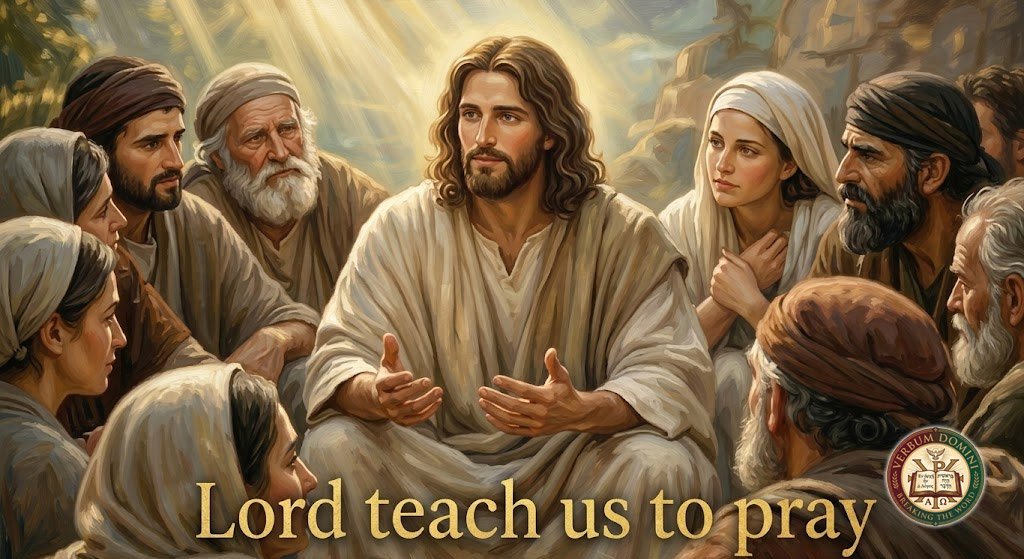
Luke often highlights Jesus retreating into solitude to pray. The disciples observe Christ emerging from an intimate, living communion with the Father. His prayer stirs their spiritual hunger. Hence, one of them asks, ‘Lord, teach us to pray, as John taught his disciples.’ The response of Jesus, is a prayer which includes every praise and thanksgiving we can give to God, every direction we can have to live a life according to God’s will, and everything we need to fulfil God’s will in our lives.
The prayer opens with the bold, unembellished call to God, our Pater (Πάτερ – Father). It bypasses lengthy formal praises common in ancient prayers and shows trust rather than fear. Hagiasthētō (ἁγιασθήτω – sanctified be) be your name, acknowledges our awe and fear, which is acknowledgement of God’s presence in our lives. It is acknowledging that God is our refuge. It also means, we wish to be with Him always, and want his Kingdom to come into our lives.
Give us kath’ hēmeran (τὸ καθ’ ἡμέραν – each day) our Epiousion (ἐπιούσιον – daily) bread. While Matthew uses sēmeron (today), Luke uses the present continuous “keep giving us day by day”. It emphasizes perpetual, daily dependence on God’s providence rather than a one-time supply. Luke also uses Epiousion one of the rarest words in the New Testament, since it holds a dual dimension:
-From epi-ousia (for existence / substance): the bread necessary to sustain bodily life day by day.
– From hē epiousa (the coming day): the bread of the eschatological tomorrow, pointing directly to the supersubstantial nourishment of the Eucharist.
Forgive us our Hamartias (ἁμαρτίας – sins). While Matthew speaks of forgiving debts (opheilēmata), Luke asks God to forgive our hamartias (moral offenses against God). The most striking feature of Luke 11:4 is the asymmetry between God’s forgiveness and our forgiveness. While Matthew (a tax collector by profession) in 6:12 “forgive us our debts, as we also have forgiven our debtors” maintains a symmetrical financial/commercial transaction metaphor throughout the petition. Luke in 11:4 “And forgive us our sins, for we ourselves forgive everyone indebted to us.” Luke (a physician) intentionally breaks the parallelism. Towards God, we do not merely have a “financial ledger” or a debt balance. By pairing hamartia with human indebtedness, Luke highlights that what we owe God is of an infinitely higher order than the everyday grievances, emotional debts, or material trespasses others owe us.
Insights for Life
The disciples did not ask Jesus, “Teach us how to preach” or “Teach us how to work miracles.” They recognized that the hidden spring of His power was His communion with the Father. They wanted the source, not merely the fruit. Prayer begins not with our grocery list of needs, but with God’s honour. When our prayers remain trapped in self-referential demands, they leave us exhausted. Christ teaches us to anchor ourselves first in God’s love and providence.
We ask the Father to forgive our sins as we forgive everyone indebted to us. Notice the uncompromising word everyone. We cannot clutch grudges in one hand and hold out the other to receive divine mercy; the fist that refuses to release an offender cannot be opened to receive God’s peace.
Before checking your phone or running through your daily obligations, stop and speak the word ‘Our Father’ slowly. Let the reality sink in that you belong to God before you belong to your tasks.
Insights from the Church Fathers
“Whatever other words we may say -whether spoken before prayer that our devotion may be kindled, or spoken during prayer that it may be sustained- we say nothing that is not contained in the Lord’s Prayer, provided our prayer is righteous and fitting.” – Saint Augustine (Letter 130 to Proba)
“How great is the Lord’s loving-kindness, how great the condescension and wealth of His goodness towards us, that He has permitted us to call God ‘Father’ when we pray… We should remember that when we call God ‘Father’, we ought to act as children of God, so that just as we find pleasure in God our Father, He may find pleasure in us.” – Saint Cyprian of Carthage (On the Lord’s Prayer)
Insights from the Carmelite Tradition
“Christ commanded us to pray: ‘When you pray, say: Our Father…’ In this prayer, He taught us all that we need to ask for, and how to ask for it with the greatest perfection, simplicity, and brevity, without relying on long, sophisticated formulas, but leaning entirely upon pure faith, hope, and charity.” – Saint John of the Cross (The Ascent of Mount Carmel, Book III, Chapter 44)
“Sometimes, when my mind is in such great aridity that it is impossible for me to draw one single thought to unite myself with God, I very slowly recite an ‘Our Father’ and then the ‘Hail Mary.’ Then these prayers alone enchant my soul; they nourish it much more than if I had recited them a hundred times in haste.” – Saint Therese of the Child Jesus (Story of the Soul, Manuscript C)
Whatsapp channel: https://whatsapp.com/channel/0029VbCwzvh3QxS6zJTriv0E