

24-10-2026, Saturday of Twenty Ninth Week in Ordinary Time
Eph 4: 7-16; Ps 122: 1-5; Lk 13: 1-9
Jesus In today’s passage shatters the human instinct to turn every tragedy into a scoreboard of guilt, but confronts us instead with an urgent call to conversion and to seek divine mercy. The passage speaks of two contemporary disasters (the slaughtered Galileans and the collapse of the Tower in Siloam), followed by the Parable of the Barren Fig Tree.
Referring to the matter raised by some people regarding the Galileans whose blood Pilate mingled with sacrifices, the crowd thinks of hamartōloi (sinners). But Jesus raises the catastrophe of the eighteen killed at Siloam, He switches to opheiletai (debtors). In Jewish expression, moral failing was understood as an unpaid debt before God. Jesus asks: “Do you think they were greater debtors than all who live in Jerusalem?” The answer is no. Death is not distributed according to an earthly audit of relative wickedness; rather, every human being carries an infinite debt that only divine mercy can remit. Jesus warns: “Unless you repent, you will all likewise perish.” The Greek metanoeō is far deeper than mere emotional remorse. It combines meta (transformation) and nous (mind, perception, innermost orientation).
The vineyard owner observes of the fruitless fig tree: “Cut it down! Why should it use up the ground?” The tree is not merely passive; its extensive root system actively leaches moisture and nutrients from the soil, exhausting land that could otherwise bear life. Fruitlessness is not benign; spiritual complacency actively drains grace from the surrounding communion. When the vinedresser pleads, “Lord, let it alone this year also”. The gardener’s plea is an act of priestly intercession, begging for a stay of judgment so that grace may do its hidden, arduous work. The vinedresser’s strategy is not cosmetic pruning; it is labour beneath the surface. Skaptō means to break through the hard, sun-baked crust around the roots to let air and water penetrate. Kopria (manure) points to what is base, decomposing, and despised in the eyes of the world.
LIFE APPLICATION
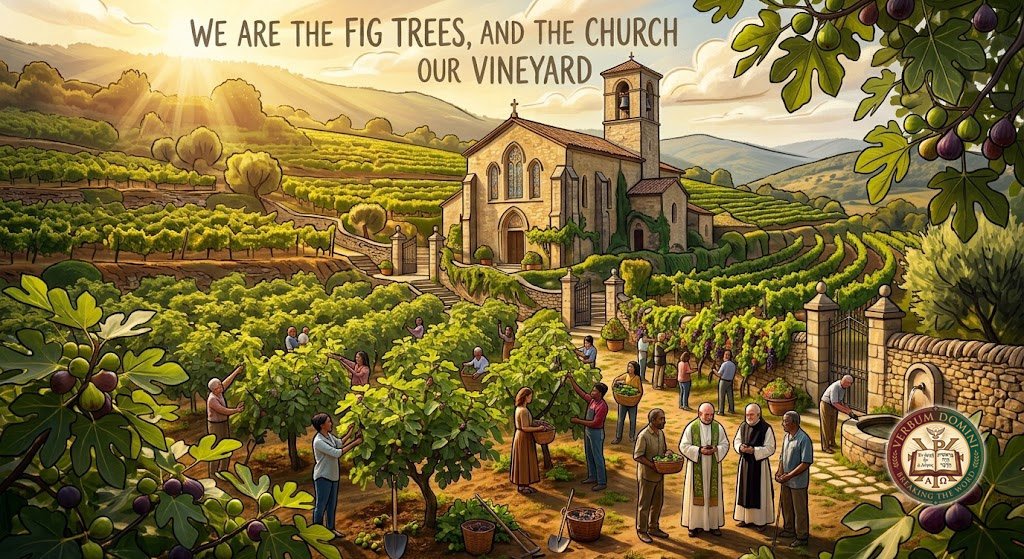
We are that fig tree. Planted not in wild wasteland, but inside the protected soil of a “vineyard”—the Church, surrounded by sacraments, scripture, and unnumbered graces. Yet, how often does the Master come seeking the sweet fruit of charity, patient meekness, and unfeigned prayer, only to find our branches clothed in nothing but leaves—the outward performance of piety without interior fruit?
The good news is that we have an Advocate: Jesus Christ, the divine Gardener, who stands between our barrenness and the axe of judgment, pleading: “Leave it this year also.” Every sunrise is that extra year of reprieve. Every confession is the soil being dug around our roots. To receive this grace requires two practical postures today:
1. Embrace the spade: Allow God’s Word to cut through the hardened, defensive layer around your heart.
2. Accept the manure: Do not despair over your weaknesses or the humiliations you encounter. When brought to the feet of Christ in humble sorrow, the very memories of our past faults and the grit of daily trials become the fertilizer of true sanctity.
INSIGHTS FROM THE FATHERS AND DOCTORS OF THE CHURCH
“What is meant by the dung applied to the roots, if not the remembrance of our sins? For from the remembrance of sin the soul quickens itself to good works, and by this holy sorrow, the heart is made fruitful anew.” – Saint Gregory the Great (Homilies on the Gospels)
INSIGHTS FROM THE CARMELITE TRADITION
“Do you know what it is to be truly spiritual? It is for men to become the slaves of God—branded with His mark, which is that of the Cross—so that He may sell them as slaves to the whole world, as He Himself was sold… This is the true end and fruit of prayer: the birth always of good works, works of charity.” – Saint Teresa of Avila (The Interior Castle, Fifth Mansions)
“I am a very little soul, who can offer only very little things to the good God… The elevator which must raise me to heaven is Your arms, O Jesus! For that, I have no need to grow up; on the contrary, I must remain little, I must become still less.” – Saint Thérèse of Lisieux (Story of a Soul)
Whatsapp channel: https://whatsapp.com/channel/0029VbCwzvh3QxS6zJTriv0E