

13-09-2026, Sunday of Twenty Fourth Week in Ordinary Time
Sir 27:30–28:7; Ps 103: 1-4, 8-12; Rom 14: 7-9; Mt 18: 21-35
Sirach 27:30–28:7
“Resentment and anger, these are foul things too, and a sinner is a master at them both.” (Sir. 27:30 NJB)
Sirach warns that whoever nourishes anger against another, vainly seeks healing (iasis, ἴασις) from God (28:3). Resentment is tied to the root nāṭar (נטר), which means “to keep or harbour”. Harbouring a grudge is literally keeping preserving an offense inside oneself. Sirach exposes the spiritual contradiction: a heart which harbours offenses by others, makes itself impenetrable to divine mercy.
Psalm 103:1–4, 9–12
Psalm 103 grounds mercy not in human capacity, but in God’s identity. Let us look at the words used for Mercy in today’s responsorial psalm
Mercy – חֶסֶד (Ḥesed, vv. 8, 11): Covenantal, steadfast love that cannot be earned. Mercyis underserved or merited but a gift.
Mercy – רַחוּם (Raḥûm, v. 4, 8): Derived from רֶחֶם (reḥem, “womb”). God’s compassion is maternal, visceral, and life-giving. Blessed is the fruit of the womb. Jesus is Mercy.
“As far as the east is from the west, so far does He remove our transgressions from us.” God does not merely overlook sins; He removes them beyond recovery.
Romans 14:7–9
Paul declares that Christ is κύριος (Kyrios, “Lord”) of both the dead and the living (v. 9). When an individual claims the right to nurse vengeance or judge a brother, they usurp the Kyrios. Since our lives belong to Christ, our personal grievances no longer belong to our private jurisdiction.
Matthew 18:21–35
Peter, leader of the Twelve, tries to understand heavenly Grace, to understand whether God’s Mercy is limited, like human forgiveness.
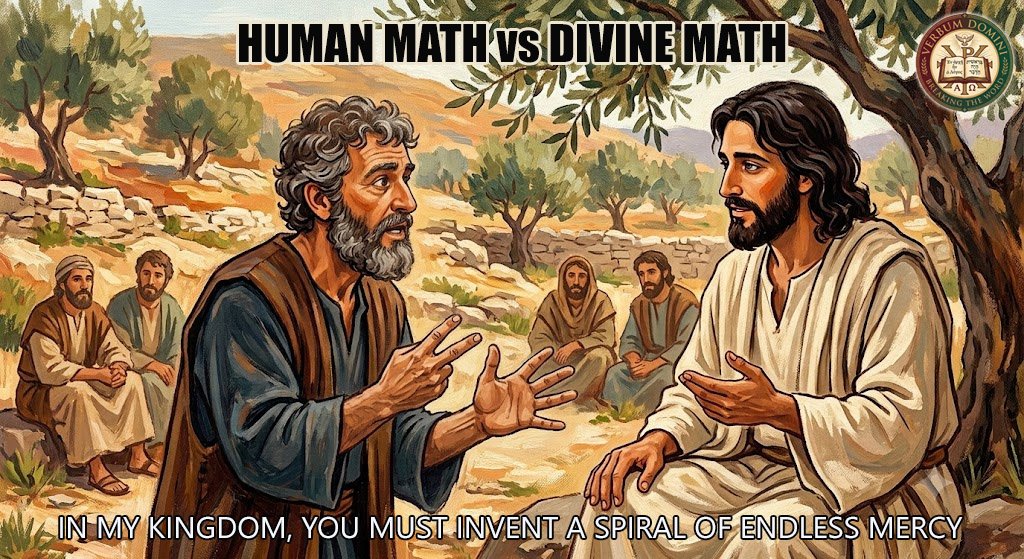
- Peter’s Math: Trying to Out-Grace the Rabbis
“Lord, if my brother sins against me, how often must I forgive? As many as seven times?” (Mt 18:21)
In mainstream rabbinic thought at the time, the prevailing pastoral consensus was that you were obliged to forgive an offender three times. On the fourth offense, mercy was exhausted; justice took over. Peter doubles the rabbinic standard and adds one for good measure: seven (hepta, ἑπτά). To a Jewish mind, seven is the number of covenant, fullness, and completion (sheva / shavua in Hebrew). Peter comes to Jesus expecting a pat on the back: “Look how magnanimous I am being. Seven times!”
- Jesus’ Math: Even forgiving Lamech
Jesus replies with words that must have stunned Peter: “I say to you, not seven times but seventy-seven times” (hebdomekontakis hepta, ἑβδομηκοντάκις ἑπτά, which can mean seventy-sevenfold). Jesus is deliberately quoting the Greek Septuagint of Genesis 4:24, where Lamech boasts to his wives: “If Cain is avenged sevenfold, Then Lamech seventy-sevenfold.” Lamech invented the spiral of endless vengeance and blood-feud. Jesus looks Peter in the eye and says: In my Kingdom, you must invent a spiral of endless mercy. There is no counting with regard to mercy in the Kingdom.
What makes Peter’s question unforgettable is the shadow of what lies ahead for him in Matthew’s Gospel.
Later in the narrative: Peter will boldly boast that even if all fall away, he will never deny Jesus (Mt 26:33).
Within hours, in the high priest’s courtyard, Peter denies his Lord not once, not twice, but three times, swearing an oath that he does not know the Man (Mt 26:69-75). When Peter denied Jesus, he broke his own rule of “three strikes and you’re out.” By his own math, he was past redemption. When the resurrected Christ meets Peter by the sea (ref. Jn 21), Jesus doesn’t demand a tally of his failure. He asks him three times, “Do you love me?” and restores him. Peter only understands the Parable of the Unforgiving Servant after he becomes the servant who owed the unpayable debt. He realizes that the Rock of the Church cannot be built on rigid legalism; it must be founded on a man who knows the agony of failure and the shock of unconditional pardon.
- The Parable of the Unforgiving Debtor
Jesus sharpens the reality of forgiveness through economic or a mathematic hyperbole.
- The debtor owes 10,000 talents. A talent was roughly 6,000 denarii (twenty years’ wages for a labourer); 10,000 was the highest numeral in the Greek counting system. It represents an unpayable, astronomical debt.
- Moved to mercy, the king releases him. Like the Hebrew reḥem, this verb denotes a visceral stirring of compassion.
- The fellow servant owes 100 denarii, roughly three months’ wages. It is insignificant compared to the forgiven debt. When the servant chokes his fellow, he forgets the infinite gulf between his own cancelled debt and the debt owed to him.
What about You and me?
- Like Peter, we love to set measurable limits on our love and forgiveness. We say, “I will forgive, but only so far, only this many times, and only if they meet my conditions.” Jesus tells the parable to show Peter that whenever we keep track of how many times a neighbour has failed us (the 100 denarii), we have completely forgotten the astronomical debt that God has already dissolved (the 10,000 talents).
- Peter could only shepherd the early Church because he knew he was a forgiven sinner. We cannot minister to others, keep our families together, or heal divisions in our parishes if we approach each other as judges. We can only do it as fellow debtors who have met the King’s mercy.
Join the whatsapp channel – https://whatsapp.com/channel/0029VbCwzvh3QxS6zJTriv0E – to get these reflections on whatsapp
Hi, this is a comment.
To get started with moderating, editing, and deleting comments, please visit the Comments screen in the dashboard.
Commenter avatars come from Gravatar.