

5-10-2026, Monday of Twenty Seventh Week in Ordinary Time
Gal 1: 6-12; Ps 111: 1-2. 7-8-10; Lk 10: 25-37
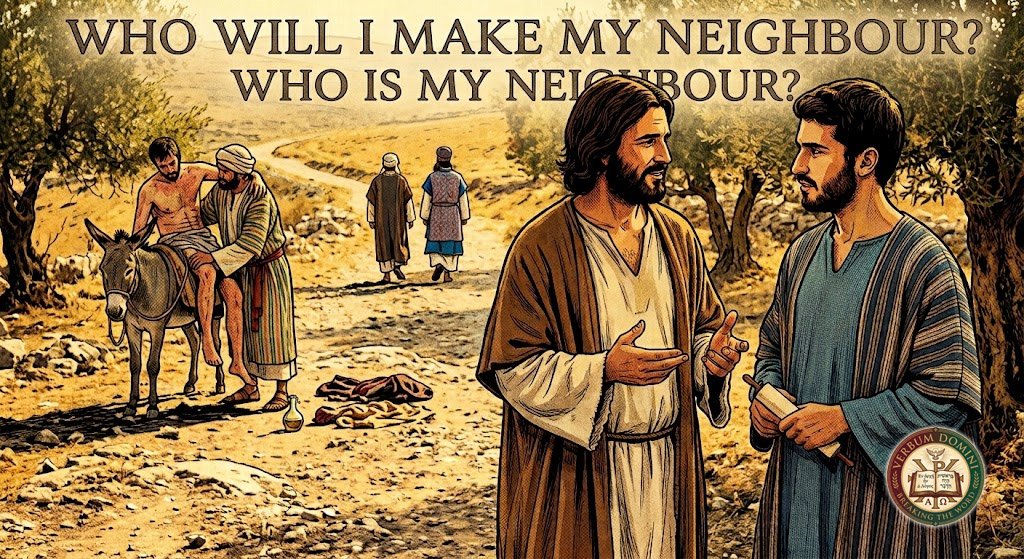
The Gospel passage presents us with a lawyer who stands up to test Jesus with the ultimate question: “Teacher, what shall I do to inherit eternal life?” (Lk 10:25). When Jesus turns the question back to the Law, the lawyer correctly recites the Shema and the command of Leviticus, but then asks, “And who is my neighbour?” (Lk 10:29). The lawyer was seeking a boundary, line across which his duty ended. In response, Jesus refuses to provide an abstract definition of a neighbour. Instead, He tells the story of a journey from Jerusalem down to Jericho.
The legalistic mind seeks limits so that virtue can be measured, managed, and catalogued. If the neighbour is strictly defined, one can fulfil the minimum requirements and remain comfortable. Both the priest and the Levite see the battered man, but they deliberately swerved to the other edge of the road. Fearing ritual defilement under the purity laws and personal danger, they set a boundary to help their neighbour.
When the Samaritan arrives, verse 33 says he was moved with esplanchnisthē (ἐσπλαγχνίσθη). This is no mild feeling of pity; it is a profound, gut-wrenching ache of divine compassion. Divine mercy is visceral; it moves the whole person to interrupt their journey.
The Samaritan’s compassion translates immediately into surgical care: he bound up his wounds pouring on oil and wine, placed him on his own beast, and brought him to an inn. May we allow Christ, our Good Samaritan, to bandage our wounds at the altar, so that we may go forth into our streets, our homes, and our workplaces to show the same mercy to every soul lying broken by the side of the road.
Insights for Life
The lawyer asked Jesus, “And who is my neighbor?” (Lk 10:29). But the parable concludes with an inversion of the lawyer’s premise, “Which of these three, do you think, proved neighbour to the man who fell among the robbers?” (Lk 10:36). The lawyer cannot even utter the word “Samaritan”; he simply replies, “The one who showed him mercy.” Jesus responds with an imperative: “Go, and do likewise.”
In daily Christian life,
-True charity requires letting another person’s suffering alter our plans.
– Our Christian witness collapses if our charity is reserved only for those who share our cultural, political, or social circles.
– Compassion did not end with initial first aid. We are summoned to enduring solidarity with the vulnerable, rather than fleeting, performative sympathy.
Insights from the Church Fathers
“Our Lord Jesus Christ wished to show that He Himself is our neighbor. He did not pass us by when we were wounded and lying in the road… The inn is the Church, where travelers returning to their eternal country are refreshed.” — Saint Augustine
“The man who was going down is Adam… Jerusalem is paradise, and Jericho is the world. The robbers are the hostile powers; the priest is the Law, the Levite the prophets. But the Samaritan is Christ… and the inn is the Church, which receives all who wish to enter.” – Origen of Alexandria
Insights from the Carmelites
“In the evening of life, we will be examined on love.” – Saint John of the Cross (Sayings of Light and Love, 64)
“The Lord does not look so much at the magnitude of anything we do as at the love with which we do it… You must not build foundations on prayer and contemplation alone; for, unless you strive to cultivate the virtues and practice them, you will never be more than dwarfs.” – Saint Teresa of Avila (The Interior Castle, Fifth Mansions, Ch. 3)
Whatsapp channel: https://whatsapp.com/channel/0029VbCwzvh3QxS6zJTriv0E Website: https://verbum.carmelmedia.in/